
To find off-market properties in Melbourne, get your finance and brief ready, build relationships with the selling agents in your target suburbs, use the early-access tools that some platforms offer, and consider a buyer’s agent who already sits inside those networks. Then run the same checks you would on any advertised home. The method is not secret, but it rewards preparation and speed.
The difficulty is that you cannot search for what nobody advertises. You refresh the portals, find thin listings, then spot a Sold sticker on a home you never saw. Selling agents usually ring buyers they already know first, so a cold enquiry from a stranger tends to sit at the bottom of a long database.
At Asset Plus Buyers Agents we act only for buyers, and finding on-market and off-market homes is the first stage of every search. This guide explains what off-market means, then walks you through four steps, from getting ready to buying safely under Victorian rules.
What off-market properties are and why sellers use them
Off-market properties are homes for sale that are not advertised publicly. There is no listing on the major portals, no signboard and no open home. The selling agent offers the property quietly to buyers they trust, so the sale can finish before most of the market knows it existed. You will also see it called off-market real estate, a silent sale or a quiet listing. They all mean the same thing.
Three kinds of off-market sale
Not every quiet sale works the same way, and the type tells you how fast you need to move.
Type | What happens | What it means for you |
True off-market | The seller never plans a public campaign. The agent approaches a short list of buyers. | No campaign deadline, but also no public bidding to show you the price. |
Pre-market | The seller is preparing a full campaign. The agent shows select buyers first, often for a week or two. | Early access, but on a clock. If no offer works, the home goes public. |
Withdrawn or passed-in | The home was advertised, then pulled or unsold. The seller may still take offers. | The seller already has a price in mind, so ask what has been offered before. |
Most buyers meet pre-market homes far more often than true off-market ones. Treat both as the same opportunity, but check which one you are looking at before you plan your timing.
Why sellers go quiet, and whether it is cheaper
Sellers choose this route for privacy, speed, convenience and lower marketing costs. A separation, a job move or a family home that people in the street should not gossip about are all common triggers. A full campaign with photography, styling and portal advertising can cost thousands of dollars, and some sellers would rather skip it when a ready buyer exists.
Off-market does not reliably mean cheaper. The price still comes from what a willing buyer pays a willing seller, and the seller usually still pays the agent’s commission. The saving is on advertising, not on the property.
Off-market means less competition, not a guaranteed discount.
Step 1. Get buy-ready before you search
Agents offer quiet listings to buyers who can act within days, so your first job is to become that buyer. Pre-approved finance, a written brief and a team on standby matter more than any search tool.
Lock in finance and a written brief
Ask your lender or mortgage broker for pre-approval before you contact a single agent. Work out your true ceiling, including stamp duty, legal fees and inspection costs, not only the purchase price. Then write a one-page brief so you can describe your search in thirty seconds.
- Budget: your maximum price and the finance behind it.
- Location: two to four suburbs, not twenty. A narrow focus gets better results than a wide net.
- Property: house, townhouse or unit, bedrooms, land size, parking.
- Deal-breakers: busy roads, flood-affected land, easements, poor orientation.
- Timing: how quickly you can settle, and whether you are buying to live in or to invest.
Line up your team in advance
Off-market windows can close in days, and you do not want to spend two of them hunting for a building inspector. Have a conveyancer or solicitor, a building and pest inspector and a mortgage broker saved in your phone before the call comes. Tell each of them you may need a quick turnaround.
Being ready also changes how agents see you. A buyer who answers quickly, holds approval and knows what they want is easy to deal with, and agents remember easy buyers.
“An off-market opportunity rewards the buyer who is ready, not the buyer who is keenest.”
Step 2. Work agent networks and early-access platforms
Selling agents hold the off-market stock, so the most direct way to find off-market properties for sale is to get onto their lists. Platforms and wider contacts add leads, but the agent relationship is the main channel.
Get on the lists of the right selling agents
Pick the three to five agents who sell the most homes in your target suburbs. Check the sold boards on your street walks and the sold results on the portals. Then introduce yourself at open homes, even for properties you will not buy, and follow up with a short message like this one.
Subject: Buyer looking in [suburb], pre-approved to $[amount]
Hi [Agent name],
I’m looking to buy a [house/townhouse/unit] in [suburb] up to $[budget]. My finance is pre-approved and I can inspect at short notice and settle in [number] days.
Could you add me to your list for pre-market and off-market properties? I’m happy to send my brief and my lender’s approval letter.
Kind regards,
[Your name]
[Mobile]
Then stay in touch every few weeks and reply within hours when they call. Agents drop buyers who go quiet and then reappear expecting the first call.
Use platforms and wider channels
Some portals, including Domain, let registered members set up a search that includes off-market and pre-market homes. Treat these as a supplement to agent relationships, because the stock is limited and other buyers see it too. Mortgage brokers, solicitors and accountants also hear about quiet sales, so tell them what you want. A polite letterbox drop in a target street can occasionally reach a seller who has not decided to list.
Be careful with social media groups that share “off-market” listings. Confirm that the person is a licensed agent with Consumer Affairs Victoria before you share personal details or pay anything.
You find off-market homes through people, so spend your effort on relationships, not on refreshing pages.
Step 3. Bring in a buyer’s agent for access
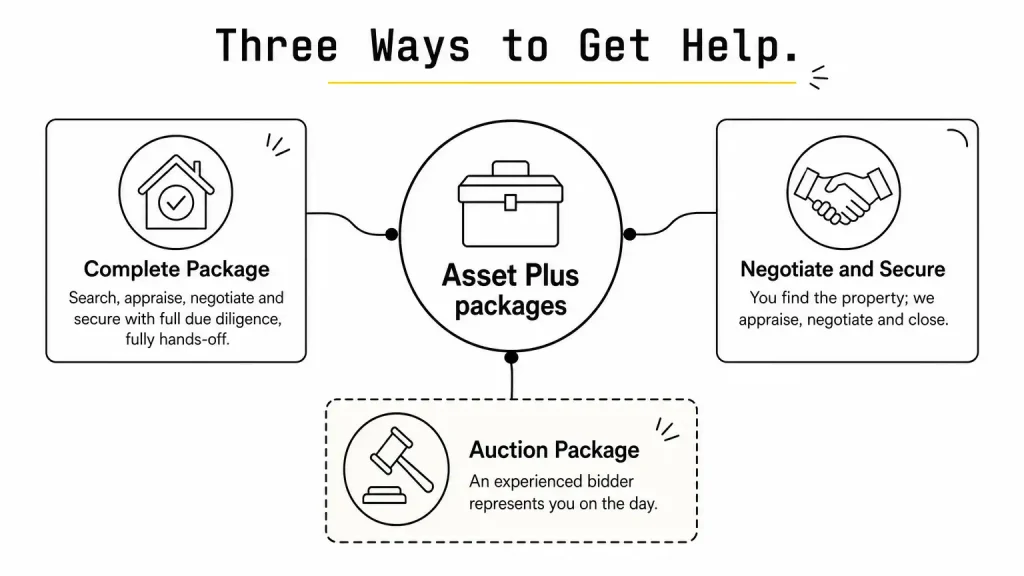
A buyer’s agent speeds up access because they talk to selling agents every week and bring clients who are already qualified. If you are time-poor, buying from interstate or targeting a tightly held suburb, this is often the most practical way into the hidden market.
Three Ways to Get Help.
- Complete Package: Search, appraise, negotiate and secure with full due diligence, fully hands-off.
- Asset Plus packages
- Negotiate and Secure: You find the property; we appraise, negotiate and close.
- Auction Package: An experienced bidder represents you on the day.
How a buyer’s agent reaches homes you cannot
Selling agents prefer dealing with buyers who are represented, financially ready and serious. They know a buyer’s agent will not waste a vendor’s time, so they ring them early, sometimes before a signboard is ordered. An individual buyer has to build that standing from scratch.
At Asset Plus Buyers Agents the search stage covers on-market and off-market properties that match your criteria, drawn from our real estate network. Principal Ajay Sachdeva has over ten years in the industry as an agent, investor and buyer’s agent. The service runs in six stages: search, due diligence, appraise, negotiate, purchase and settlement. Our three packages let you pick your level of help.
- Complete Package: search, appraise, negotiate and secure with full due diligence, fully hands-off for you.
- Negotiate and Secure Package: you find the property, we appraise it, negotiate and close.
- Auction Package: an experienced bidder represents you on the day.
What to ask before you hire one
Interview more than one buyer’s agent, because quality varies. Ask these questions and expect direct answers.
- Do you work only for buyers, or do you also sell property?
- How much of your work comes from off-market and pre-market deals?
- How is your fee structured (fixed or a percentage), and when is it payable?
- What is included: due diligence, inspections, negotiation, auction bidding?
- Who will I deal with day to day?
Get the fee terms in writing before any work starts. Weigh the fee against what you save in time and what you avoid paying in an auction contest.
“A buyer’s agent sells you access and judgement, so choose one on those two things, not on price alone.”
Step 4. Check, negotiate and buy safely
Buying off-market in Victoria gives you the same legal protections as any private sale, and you still need every check. The absence of competing bidders is an advantage, not a reason to skip due diligence.
Do the checks a public listing would get
Insist on the Section 32 vendor’s statement before you sign. It covers title, planning, any mortgage or caveat, and owners corporation details for apartments. Have your conveyancer or solicitor review it, and book a building and pest inspection. Also check flood history and easements, and compare recent sales nearby so you know the fair price. With no auction to reveal the market, your research is the only price test.
In most private sales you also get a cooling-off period of three clear business days after signing. If you use it, you forfeit the greater of $100 or 0.2% of the price. On a $900,000 purchase, 0.2% is $1,800, which is more than $100, so you would forfeit $1,800. Cooling-off does not apply at auction or in the three clear business days either side of a publicly advertised auction, so confirm your position with your conveyancer.
Negotiate without competing bidders
Start by asking why the seller is going quiet. If speed drives them, a short settlement may be worth more than a few thousand dollars. If privacy matters, reassure them about discretion. Base your opening offer on comparable sales, because too low can end the conversation and too high means you overpay with no one pushing you to.
Be ready to walk away. Sellers sometimes test the market quietly, reject offers and then list publicly. If your limit is set in advance, that outcome costs you nothing.
“With no rival bidders, your research and your willingness to walk away set the price.”
Start your off-market search with a plan
Off-market properties are homes sold without public advertising, and in Melbourne you reach them through preparation and relationships. Get your finance and brief ready, join the lists of the busiest agents in your suburbs, add platform alerts and wider contacts, and consider a buyer’s agent for faster access. Then check the Section 32, inspect the building and negotiate from comparable sales.
If you would rather have someone with the network and the negotiating experience do the legwork, you can talk to Asset Plus Buyers Agents about your search and book a 30-minute appointment to map out your next steps.