
SMSF property is real estate owned by a self-managed super fund, with the trustees holding the title for the members’ retirement benefit. You can invest in property with an SMSF, residential or commercial, if the purchase meets the sole purpose test, is made on commercial terms and sits in the trustees’ names. You cannot live in the property, rent a residential property to a relative, or buy residential property from a related party. Borrowing is allowed only through a tightly structured loan.
Buying property in super suits some investors. It also concentrates risk, costs more to run than a large fund and leaves little room for error. Breaches of the rules can lead to penalties from the ATO, which regulates SMSFs, and in serious cases to the fund losing its concessional tax treatment.
This article covers why SMSF property appeals, how a purchase works step by step, the rules that limit what you can buy, and how borrowing and costs play out with a worked example. Asset Plus Buyers Agents acts only for buyers, including investors who buy through their SMSF, so we see where these purchases succeed and where they stall.
Why SMSF property appeals to investors
SMSF property appeals because of its concessional tax treatment and the control it gives trustees over what the fund owns. It is not automatically better than other investments, and the same features that attract investors also create its main risks.
Tax and control
In the accumulation phase, a super fund pays tax of up to 15% on net rental income. Capital gains on an asset held for more than 12 months are discounted by one-third, which makes the effective rate about 10%. In the retirement phase, earnings on assets that support a pension can be tax-free, within the transfer balance cap. The ATO sets out the detail, so check the current figures on ato.gov.au.
Control is the other draw. You choose the asset, the timing and the strategy, rather than relying on a fund manager. Business owners can also buy their own commercial premises through the fund and pay market rent to it. That is one of the few ways a related party can legitimately lease property from an SMSF.
Tax concessions only help if the property performs and the fund stays compliant.
The trade-offs
Property can work well inside super, but these costs are real:

- Concentration: one property can dominate a small fund, so a vacancy or a price fall hits the whole balance.
- Liquidity: you cannot sell a bedroom. Pensions and lump sums must still be paid, and the fund needs cash for them.
- Running costs: the fund pays for an annual independent audit, accounting and a tax return. ASIC has found that SMSFs with balances below about $500,000 tend to cost more and return less than large funds.
- Compliance: the trustees carry the legal responsibility, whatever advice they receive.
How to buy property through your SMSF
You buy property through an SMSF by confirming the fund is allowed to, documenting the strategy, arranging the money, then signing the contract in the trustees’ names. Skipping an early step is the most common way purchases go wrong.
Steps from set-up to settlement
- Check the trust deed. It must permit property investment and, if you plan to borrow, borrowing.
- Update the investment strategy in writing. It must consider diversification, liquidity, risk, the fund’s ability to pay benefits and members’ insurance needs.
- Line up the money. Confirm cash, contributions and, if borrowing, approval from a lender that offers SMSF loans.
- Set up the holding trust. A borrowing purchase needs a separate trust, often called a bare trust, to hold the title.
- Choose a property that passes the rules. Get an independent valuation so the price is supportable as market value.
- Sign in the trustees’ names. The deposit and every cost must come from the fund’s bank account, never your personal one.
- After settlement, run all rent and expenses through the fund and keep records for the auditor.
The fund must make the decision, document it and pay for it. You cannot do any of that as an individual.
Where a buyers agent fits
Your accountant or SMSF specialist handles compliance, and your broker handles the loan. A buyers agent handles the property side. That means searching on-market and off-market listings, appraising true market value, checking flood history and easements, and negotiating the price. Because an SMSF loan often has a tight finance deadline, this work cannot drag on. This is general information, not financial advice, so speak to a licensed adviser about your own fund.
The rules that decide what your fund can buy
A handful of rules in the Superannuation Industry (Supervision) Act decide whether a property purchase is allowed. The ATO’s SMSF investment restrictions page covers them in detail.
The core rules at a glance
| Rule | What it means in practice |
|---|---|
| Sole purpose test | The property must exist to provide retirement benefits, not a present benefit to anyone |
| Arm’s length dealing | Buy, sell, lease and borrow at market value and on commercial terms |
| Related-party purchases | Residential property cannot be bought from a member or relative. Business real property can |
| No personal use | Members and relatives cannot live in or holiday in a residential fund property |
| In-house assets | Loans to, leases with and investments in related parties are capped at 5% of fund assets |
| Business real property | It can be leased to a member’s business at market rent, and the lease is exempt from the in-house limit |
| Title | The property must be held in the trustees’ names, or a holding trust’s if borrowing |
Residential versus commercial
Residential property carries the strictest limits, because personal use is banned outright. The rent comes from outside tenants and the fund bears all the costs.
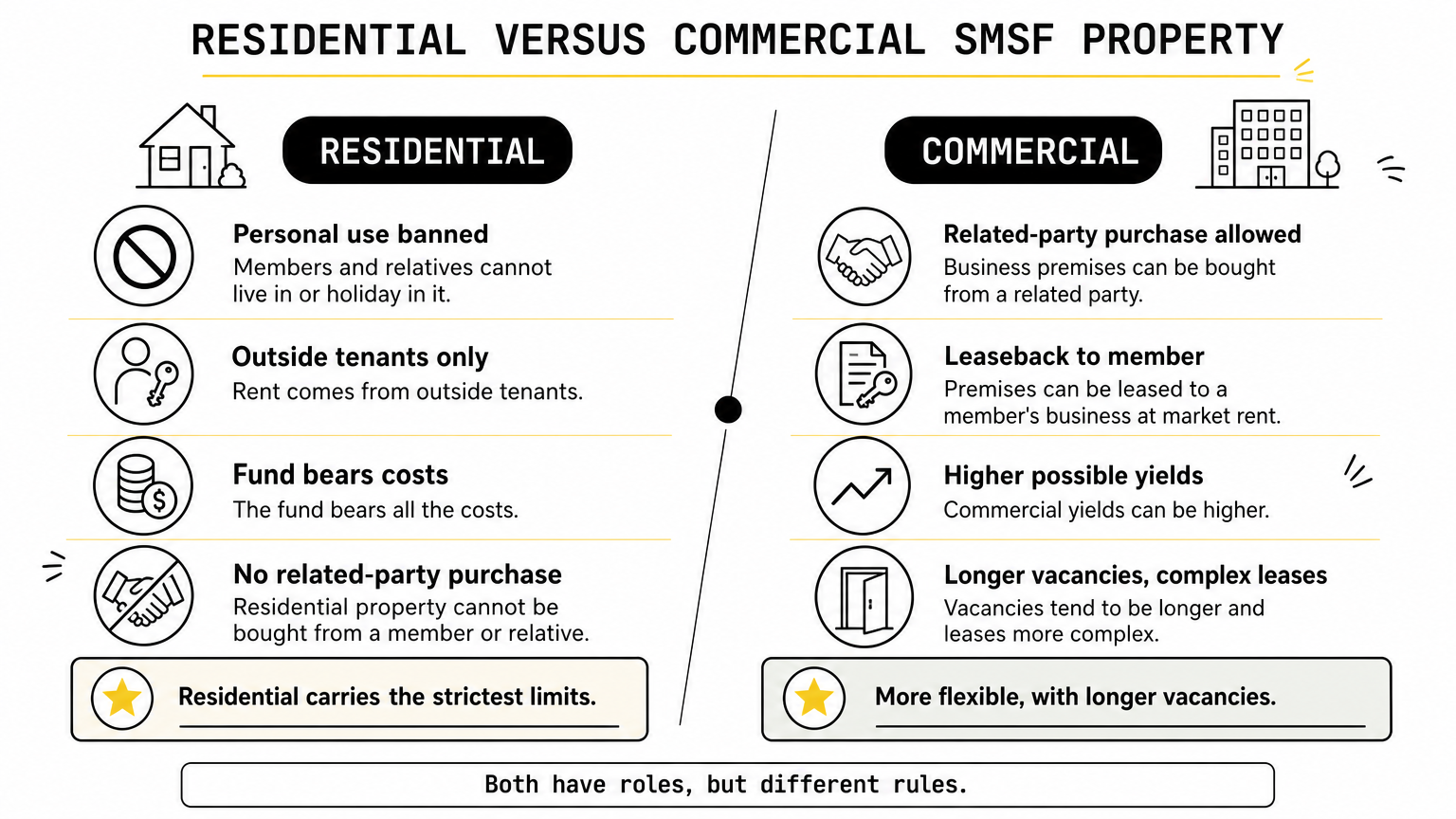
Commercial property is more flexible. Premises used wholly for business can be bought from a related party and leased back to a member’s business, provided the transaction is at market value and documented. Commercial yields can be higher, but vacancies tend to be longer and leases more complex.
If any member or relative benefits from the property today, the sole purpose test is probably breached.
How borrowing and costs work in an SMSF
An SMSF can borrow to buy property only through a limited recourse borrowing arrangement (LRBA). If the fund defaults, the lender can claim only the property bought with the loan, not the fund’s other assets.
How an LRBA works
The property sits in a separate holding trust until the loan is repaid. Each loan must be for a single acquirable asset, so you cannot bundle several properties into one loan. You can use borrowed money for repairs and maintenance, but not for improvements that change the character of the property. Those must be paid from the fund’s cash flow.

Lenders also tend to ask for larger deposits than a personal loan and often want cash reserves left in the fund. Many want personal guarantees from members, which put your own assets at risk even though the loan is “limited recourse” to the fund.
Recent reforms have restricted new LRBAs for residential property, with cash purchases still allowed. Check the current position with your SMSF specialist and the ATO before you commit to any loan.
A worked example
Say your fund holds $400,000 and buys a $600,000 commercial property. These figures are assumptions for illustration.
| Item | Amount |
|---|---|
| Purchase price | $600,000 |
| Deposit (30%) | $180,000 |
| Loan | $420,000 |
| Stamp duty, legal and loan costs (assumed) | $35,000 |
| Cash out of the fund | $215,000 |
| Cash left in the fund | $185,000 |
The fund’s net assets are now about $365,000, with $600,000 of property sitting against them. One asset carries nearly all the risk, and the loan repayments depend on rent arriving on time. Stamp duty varies by state, so your own figures will differ.
Run the numbers on a vacancy of six months before you sign, not after.
Is SMSF property right for you?
SMSF property can work if your fund is large enough to absorb the costs, you can spare the cash and you are willing to stay inside the rules. It does not suit a small balance, a short timeframe or anyone who wants to use the property personally. Concentration and liquidity are the risks that most often catch trustees out.
If you decide to go ahead, get your accountant, broker and solicitor lined up first, then bring in someone to handle the property search and negotiation. You can book a conversation with Asset Plus Buyers Agents to talk through finding and securing a property for your fund.